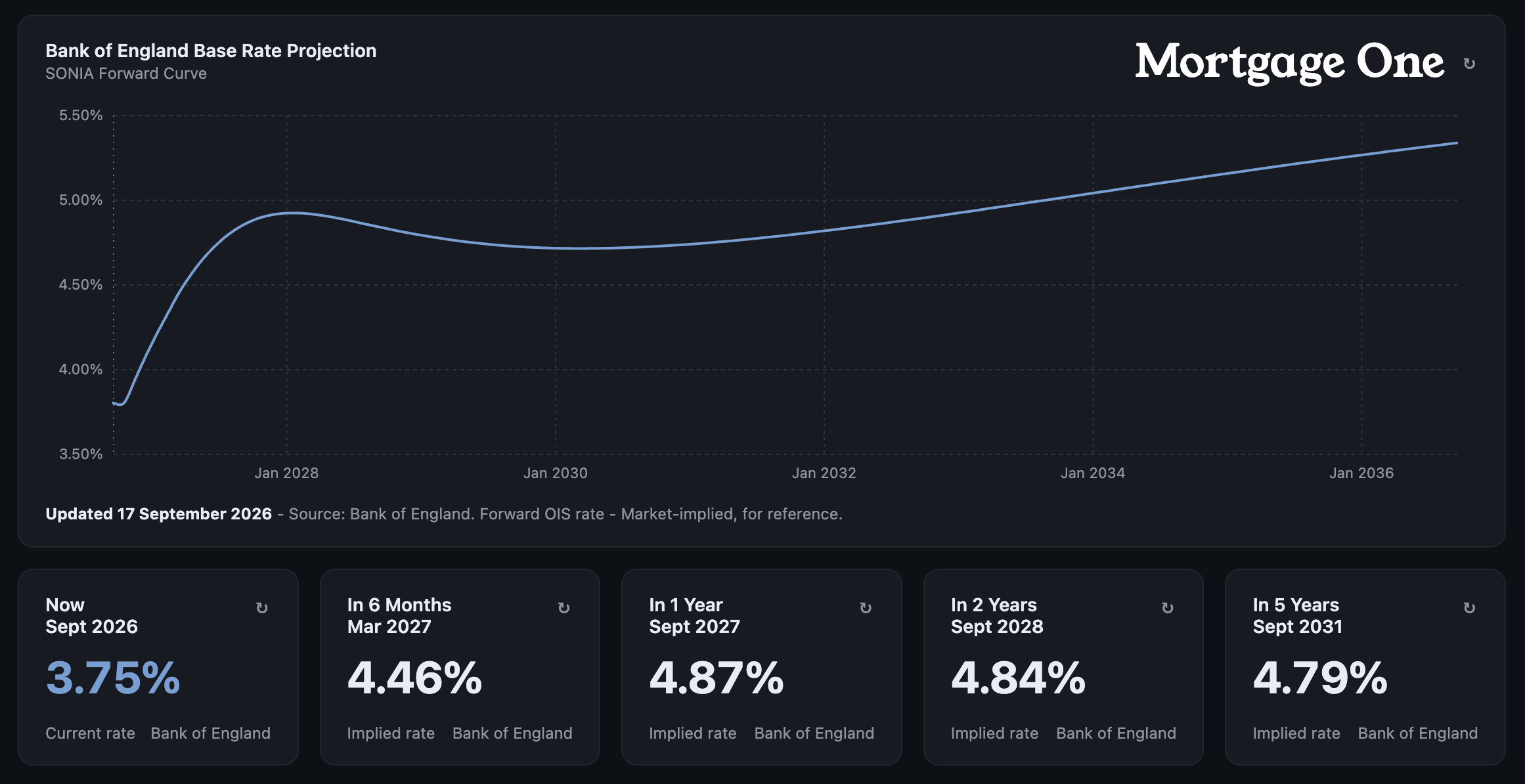
Next Bank of England Meeting: Sixth Hold, Same Three Votes for 4%
The next Bank of England meeting concludes on Thursday 5 November 2026 and comes with a new Monetary Policy Report. On 17 September the Committee held Bank Rate at 3.75% for a sixth time, again by 6-3, with the same three members voting for 4%. Inflation is 3.1% and the Bank says it is likely to rise further, so November is where the case for a rise gets tested. Mortgage One is a whole of market mortgage adviser helping borrowers reserve and compare fixed deals ahead of the November Bank Rate decision.

London House Prices Falling: Some Areas Down 25% as Rents Rise
London is the weakest housing market in the UK on the latest official figures, and the weakness is concentrated in a handful of central boroughs rather than spread evenly across the capital. Average London prices dropped 2.5% in the year to June 2026 while rents rose 3.0% in the year to July, a split that changes the maths for buyers, movers, remortgagers and landlords in different ways.

Lenders Cut Rates While Markets Predict the Base Rate Will Rise
Lenders cut fixed mortgage rates for a second week running in the week to 14 August 2026, with Santander, NatWest, Coventry, Accord and Halifax all repricing lower. In the same week the forward curve had the Bank of England base rate rising from 3.75% to 4.37% within twelve months. Set side by side those two facts look like a contradiction, and they are not.

Andy Burnham and UK Mortgage Rates: Gilt Yields, Swaps and Your Fix
Andy Burnham has returned to Parliament, and the bond market wasted no time reacting. Gilt yields rose, the swap rates that price fixed mortgages followed, and the same week brought borrowing figures showing the deficit running well ahead of forecast. For anyone with a remortgage on the horizon, a Westminster leadership contest has quietly become a question about the rate on their next deal. This is a broker's read on what Burnham's rise means for UK mortgage pricing, and what to do about it.

Should I Fix My Mortgage: Why the Balance of Risk Points Higher
The rate cut that homeowners spent the start of 2026 waiting for has not arrived. The Bank of England has held the base rate all year, and its tone has shifted from cutting to the possibility of raising. Yet several lenders are still trimming fixed rates right now, which leaves borrowers with a genuinely two-sided decision.

Iran Ceasefire Collapse: What It Means For UK Mortgage Rates
The US-Iran ceasefire collapsed on Wednesday 8 July 2026 and UK borrowing costs moved within hours, with oil, gilt yields and the swap rates behind fixed mortgage pricing all climbing. If your fixed deal ends this year, the three weeks before the Bank of England’s 30 July decision now carry real weight. Mortgage One is a whole of market mortgage adviser guiding borrowers through remortgage and purchase decisions while the conflict unsettles lender pricing.

Mortgage Rate Cuts: Lenders Lower Fixed Deals as Base Rate Holds
UK lenders are cutting fixed mortgage rates again, and the reason is not a move in the Bank of England base rate. Fixed pricing is set in the wholesale funding market, and that market has shifted in borrowers' favour over recent weeks.

Mortgage Rates in 2026: Autumn Rises and the Two-Year Fix Bet
Mortgage rates in 2026 have swung twice: sharp rises through the spring, two months of falls into early summer, then a second climb through September that has taken average fixed pricing close to 6%. Through all of it borrowers have kept making the same choice, comparing two-year fixes in growing numbers.

UK House Prices Falling: May Drop, Forecasts and Buyer Leverage
UK house prices have fallen for the first time this year, according to Nationwide's latest index, and annual growth has slowed sharply. For anyone buying, moving or remortgaging in 2026, the detail matters more than the headline. Prices are softening at the same time as lenders trim fixed rates, and together those two moves change the negotiating and borrowing picture.

NatWest, Barclays and Santander Cut Mortgage Rates in June 2026
Three of the UK's biggest lenders have moved on mortgage pricing in the space of a week. NatWest, Barclays and Santander have all reduced selected fixed rates, and they are not alone. The reductions are welcome for anyone buying or remortgaging, but they arrive in a market where the Bank of England has warned that inflation could climb again later in the year. For borrowers, the question is less whether rates are falling and more whether to act on the current window or wait to see how far it runs.

Fixed or Tracker Mortgage: Costs, Risks and 2026 Timing
Choosing between a fixed rate and a tracker is one of the sharper decisions facing borrowers in 2026. Several lenders have trimmed fixed rates again in early June, yet the Bank of England base rate is still on hold and the path for further cuts is far from settled. That leaves a genuine choice: lock in the certainty of a falling fixed rate now, or take a tracker and follow the base rate down if more cuts arrive. This article explains how each option works, where the risks sit and what to weigh before you decide.

Remortgaging in 2026: When to Switch as Fixed Rates Ease Again
Fixed mortgage rates have started easing again after a sharp climb through the spring, and that shift changes the calculation for anyone whose deal is ending this year. The pull-back is partial rather than a return to the lows seen at the start of 2026, so the real question is not whether to hold out for a perfect rate but when a switch genuinely fits your deal, your timing and your plans. This article sets out where fixed rates sit now, why they are moving and how to judge the right point to remortgage.

Buy-to-Let Remortgaging in 2026: Rental Stress Tests and Timing
For landlords whose fixed deal ends in 2026, the decision to remortgage rarely turns on the headline rate alone. The constraint that usually decides a buy-to-let case is the lender’s rental coverage test, and that test has just been nudged in landlords’ favour by a fall in swap rates in late May. This article explains how the latest market move feeds through to buy-to-let affordability, why the stress test sets your loan size, and how to approach timing if your deal is among the large number maturing this year.

Santander Mortgage Rate Cuts May 2026: Trackers, Fixes and BTL Detail
Santander cut UK mortgage rates from 11 May 2026, with the largest moves at up to 50 basis points on selected tracker products and up to 23 basis points on buy-to-let fixed rates. The cuts span the first-time buyer, homemover, remortgage and buy-to-let ranges, and one first-time buyer product moved the other way. For borrowers timing a deal in May, the question is whether to act now or wait for the next Bank of England decision on 18 June.
Are UK Mortgage Rate Cuts About to End?
Lenders kept cutting rates this week. Nationwide, HSBC, Halifax and Santander all moved fixed pricing down. But behind the headlines, the wholesale funding market is moving the other way. Here is what that means for anyone with a remortgage or purchase decision in the next six weeks.

Nationwide Cuts Mortgage Rates by Up to 0.36% from 12 May 2026
Nationwide cut fixed mortgage rates by up to 0.36 percentage points on 12 May 2026, with reductions running across two-year, three-year and five-year fixed deals for first-time buyers, home movers and remortgage borrowers. The lender's lowest available rate is now 4.35% at 60% loan-to-value. First-time buyer rates received the largest single reductions in the latest move.

Lloyds £5,000 Deposit Mortgage: 98% LTV Criteria and Alternatives
Lloyds Banking Group has launched a new 98% loan-to-value mortgage for first-time buyers with a £5,000 deposit, available through Lloyds, Halifax and Bank of Scotland.

Gilt Yields at 26-Year High: Labour Risk and UK Mortgage Rate Impact
The 30-year gilt yield touched 5.79% this week, the highest level since 1998, as Labour leadership doubt and fiscal concern push investors to demand more to hold long-dated UK debt. Wes Streeting’s resignation from cabinet on 14 May has sharpened the political risk premium.